
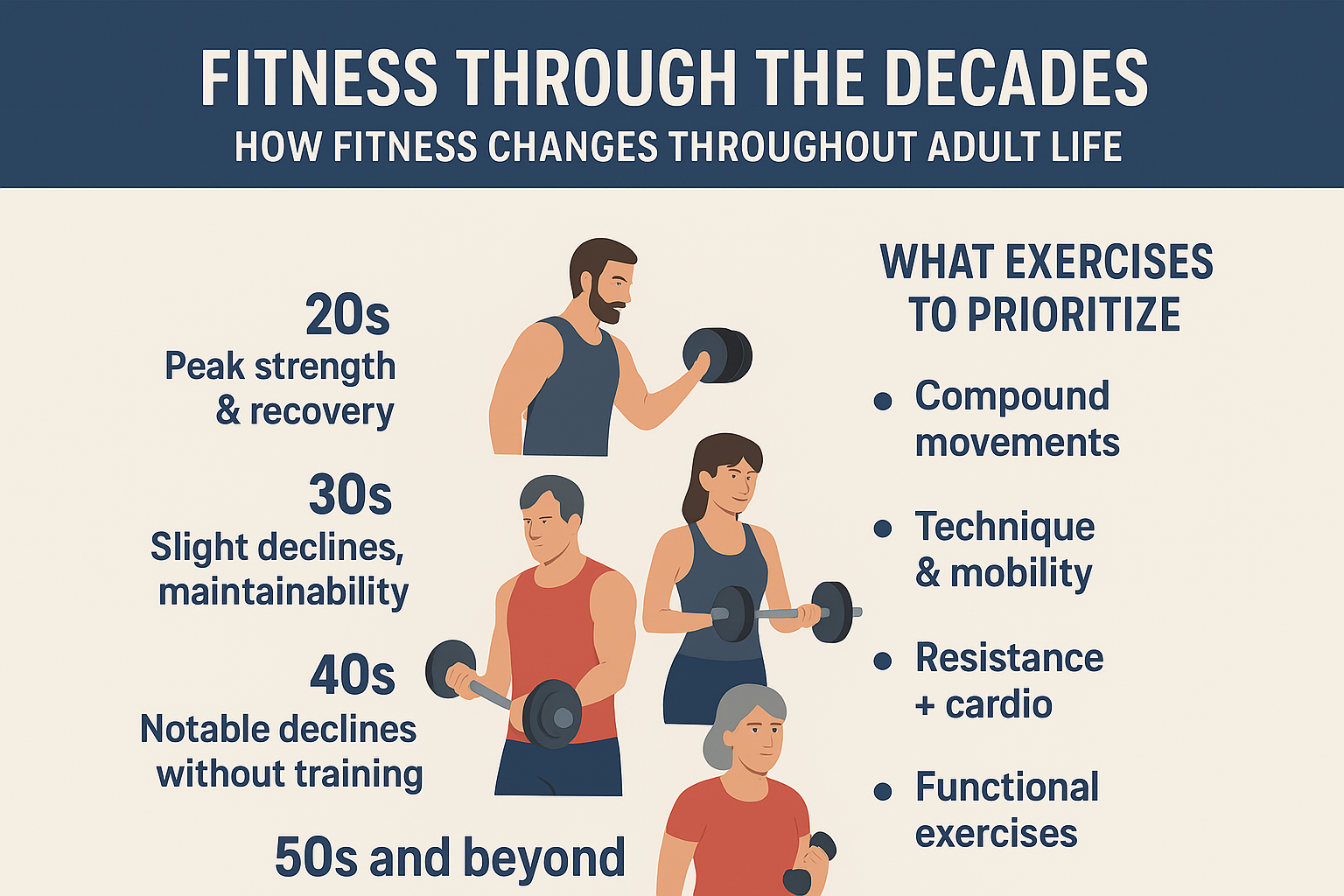
Here’s a deep dive into Fitness Through the Decades — how our bodies change, how muscles are built, what exercise makes sense at different life stages (20s, 30s, 40s, etc.), and how things differ for men vs. women. If you like, I can also pull in visuals or quote recent studies — this is a long-form guide.
How Muscle Growth Works
Before we go decade by decade, it helps to know what’s happening under the hood. Muscle growth (hypertrophy) and strength involve several interacting systems:
- Muscle fiber stimulation & damage: Lifting weights or doing resistance exercise causes microscopic damage to muscle fibers. The repair process leads to growth, provided the body has sufficient protein, rest, and hormonal support.
- Mechanical tension: The force placed on muscles, especially under load, that tells the muscle “we need to adapt.”
- Metabolic stress: Accumulation of metabolites (lactic acid, etc.) during work helps signal adaptation.
- Hormones & growth factors: Testosterone, growth hormone, IGF-1, etc., contribute significantly to muscle repair, growth, and remodeling. These vary with age, sex, and other factors.
- Neural adaptation: Early strength gains often come from the nervous system becoming more efficient at recruiting muscle fibers (motor units), better coordination, etc.
Nutrition (especially protein), rest and recovery, and consistency are all essential. Without them, even perfect training won’t yield optimal gains.
Fitness & Body Changes by Decade
Here’s what tends to happen in each major decade of adult life, what to expect, and what fitness strategies tend to work best.
| Decade | Typical Body Changes / Capabilities | What Exercises to Prioritize | What to Watch Out For |
|---|---|---|---|
| 20s (20-29 years) | Peak of many physical capacities: maximal strength growth potential, high recovery ability, high hormone levels (especially testosterone in men). Muscle can grow fairly quickly if training well. Cardiovascular capacity is high; injury recovery tends to be faster. | – Build a strong foundation: compound movements (squats, deadlifts, push-/pull exercises). – Mix in strength + hypertrophy work (heavier weights + moderate reps). – Add mobility, flexibility, prehab (to ensure long-term joint health). – Cardio & interval work to support overall fitness. |
Overtraining risk: too much volume without recovery can trap you here. Also, form issues can set in if pushing heavy without good technique. Injuries from poor mechanics may appear. |
| 30s (30-39 years) | Some gradual declines may begin (especially in recovery speed), but if well trained, many people maintain or even improve strength. Hormonal levels start a slow drift; metabolic rate may slow (weight can creep up). | – Keep resistance training consistent; perhaps more focus on technique, mobility, core strength. – Prioritize compound lifts, but include accessory work. – Balance strength with conditioning and cardiovascular health. – Recovery becomes more important: sleep, nutrition, flexibility, rest days. – Possibly periodization (cycling heavier / lighter weeks) to avoid overuse. |
Recovery takes longer. Risk of burnout, overuse injuries (e.g. joints, tendons). Metabolism changes may lead to fat gain if caloric balance is off. Time constraints may reduce training volume or consistency. |
| 40s (40-49 years) | More noticeable declines in aerobic capacity and some strength if not maintained; muscle mass (especially in the lower body) begins to decline without stimulus. Hormone levels (testosterone, growth hormone) decline. Recovery slower. Risk of joint issues, less flexibility, more risk of cardiovascular issues. Studies show strength and aerobic capacity can drop ~15-20% from early adulthood to middle age if untrained. Nature | – Resistance training remains essential. Focus on maintaining muscle mass: moderate to heavy loads, sufficient volume. – Include lower-body strength work to prevent leg muscle loss. – Emphasize joint health & mobility work: stretching, foam rolling, perhaps yoga or pilates. – More rest/recovery: active rest days, maybe periodization. – Include cardiovascular and metabolic conditioning. – Monitor nutrition carefully: protein intake, caloric balance. |
Injuries become more common (joint, tendon, cartilage). Recovery takes longer. Sleep quality may suffer. Need to avoid overtraining and work within one’s limits while still pushing appropriately. |
| 50s and beyond (50-60s, 60+) | Further declines in muscle mass (sarcopenia), strength, bone density. Hormonal declines continue. Cardiovascular capacity declines unless maintained rigorously. Balance, flexibility, and mobility are often compromised. Risk of chronic disease increases. | – Resistance training is still very important: not only to preserve strength and muscle, but for bone health. Lower weights may be used but with solid technique, higher frequency. – Emphasize functional movement: things that support day-to-day life (lifting, stepping, balance). – Mobility, flexibility, balance training (e.g. yoga, tai chi) to reduce fall risk. – Cardiovascular work that is joint friendly (walking, swimming, cycling). – Recovery, rest, nutritional support (good protein, possibly nutrition advice) become even more critical. – Maybe include more de-loading phases (lighter training) or active recovery. |
Risk of injury, overuse, illness. Slower recovery. Possible chronic joint or mobility issues. Must be cautious about cardiovascular risk in heavy training, check with medical professionals if underlying conditions. Also hormonal changes (menopause for women, etc.) bring shifts in body composition and fat distribution. |
Men vs. Women: Key Differences
Some general differences to understand, though there are always large individual variations.
- Hormones: Men have significantly higher levels of testosterone, which tends to allow greater absolute gains in muscle mass and strength. Women have lower testosterone but still build strength and hypertrophy, often in similar relative percentages. Studies show that resistance training provokes similar relative increases in muscle size and strength for many muscle groups between sexes. Nature+2PeerJ+2
- Body composition: Women tend to have higher body fat percentages, more fat stored in certain areas (hips, thighs, etc.), and smaller total lean muscle mass than men. This affects performance, metabolism, and how fat is lost/gained. BioMed Central+1
- Muscle distribution & strength differences: Women often have relatively more lower-body muscle proportional to size, whereas the upper-body difference in strength is more pronounced (men tend to have much higher upper-body absolute strength). But in relative terms (e.g. strength per lean mass, or percentage improvement from baseline), women often show similar or occasionally better gains for certain muscle groups. Nature
- Recovery & fatigue: There are sex-based differences in fatigue, in hormonal cycles, and in how the body responds to training stress. For example, menstrual cycles can influence strength, endurance, injury risk. Older women undergo menopause, which changes hormone levels, bone density, fat distribution, etc.
- Risk factors: Women are also more prone (on average) to osteoporosis, especially post-menopause; joint issues may differ. Men have other risks (e.g. cardiovascular), but both sexes face increasing risks with age.
Putting It All Together: What You Might Expect from Your Body (Changes)
If you train reasonably well and keep active, here are what many people see, roughly:
- In your 20s: Faster strength gains, good muscle tone, aesthetic changes fairly quick. Less fat gain when eating well; good energy.
- By your 30s: Might notice small slowdowns in recovery time, fat might creep in a bit especially if lifestyle changes (desk jobs, kids, etc.). May need to pay more attention to mobility, flexibility.
- In your 40s: Without regular resistance training, muscle mass may decline noticeably; strength loss in lower body especially. Stiffness, joint discomfort more common. Cardiovascular capacity declines somewhat. If trained, you still maintain a lot, but training has to be more intelligently designed.
- In 50s into 60s+: Sarcopenia (muscle loss) accelerates unless countered; bone density declines (risk for osteoporosis), balance might become an issue. Fat distribution may shift (more abdominal fat, etc.). But with proper training & nutrition, many people maintain strong, functional, healthy bodies. Changes are slower.
What You Should Focus on, by Stage
Here are practical suggestions for what types of exercise, training strategies, and lifestyle habits are especially valuable at each stage.
- Foundational strength & movement quality (early adulthood): squat, hinge (deadlift), push, pull, carry, core control. Emphasize good technique.
- Mix of hypertrophy + strength: moderate reps (6-12) + heavier (3-5) when ready.
- Cardio + conditioning: Both for health and to support fat balance, heart health. HIIT can be included, but as age advances, maybe more steady-state plus low impact options.
- Mobility, flexibility, joint work early, so you don’t lose it later. Hip & shoulder mobility, thoracic spine, ankle flexibility.
- Recovery becomes a bigger part: sleep, nutrition, stress management. Maybe include things like massage, foam-rolling, good warming up and cooling down routines.
- Adapt training volume: As decades progress, you might do fewer hard maximal effort days, more variation, lighter days or active recovery; periodization so you don’t burn out.
Overall Tips for Staying Fit Through the Decades
- Consistency is far more important than perfection. Even small, regular work adds up.
- Aim for progressive overload, but in sustainable increments.
- Prevent injury: form, listening to your body, adequate rest.
- Nutrition tailored to your age, sex, goals: protein especially becomes more critical as you age.
- Include both strength and cardiovascular health.
- Mind your mental health: fitness isn’t just physical. Self-esteem, stress, mood are part of the picture.
Important Differences to Keep in Mind
- Women may need to plan around hormonal cycles (menstrual cycle, perimenopause, menopause) – strength, fatigue, recovery can vary.
- Men may have higher capacity for rapid gains in early years, but also risk of overtraining or neglecting flexibility/mobility.
- Bone health: women are more at risk of osteoporosis post-menopause, so weight bearing and resistance is especially important.
- Fat distribution changes differ: with age women often accumulate fat differently (around midsection etc.), and men may too; metabolic rate differences.
- Motivational factors / lifestyle may differ: career, family responsibilities, etc., which can impact time for training, rest, consistency.
Summary
Fitness isn’t one-size-fits-all, and what works best at 25 may be different than what works best at 55. But the principles are fairly stable: resistance training + progressive overload, cardiovascular health, good nutrition, proper recovery, and paying attention to movement quality. If you adapt your training to your age, sex, and stage of life, you can maintain strength, health, mobility, and quality of life across decades.
Contact us if you need help with a training program tailored to your age, gender, and specific needs.